Turning Digital Insurance Quotes into Better Business Decisions
Improving digital conversion is not simply about reducing friction. It's about helping customers make informed decisions while creating more valuable opportunities for the business.

In insurance, generating digital interest is only part of the challenge. Turning that interest into a completed purchase is often a much more complex process, particularly when customers need to compare options, understand coverage, or seek reassurance before committing.
I recently worked on a project with an established insurance provider (I'm writing this in late 2026, in case you're reading from the future) facing precisely this challenge: how to turn existing digital demand into more effective online conversion, without losing the value of human assistance.
What initially appeared to be a conversion optimization project soon revealed a broader opportunity to rethink how digital experiences support customer decisions and business growth.
Understanding where conversion breaks down
The first step was to understand what was actually happening along the customer journey.
By combining digital analytics, behavioral insights, and discussions with business and technology teams, we identified a revealing pattern: customers were not necessarily struggling with the number of steps in the process.
The most significant drop-offs occurred at critical moments of transition. Some customers reached the quotation results but did not proceed. Others started the purchasing process but abandoned it shortly afterward.
These patterns raised an important distinction: was the problem usability, insufficient information, lack of confidence, or simply a customer who was not yet ready to buy?
The existing data could tell us where people stopped, but not always why.
And that's one of the things I particularly enjoy about this kind of work: data has a rather useful habit of challenging our assumptions. Especially the ones we're most comfortable with.
This distinction helped shift the conversation from simplifying forms to understanding the decisions behind customer behavior.
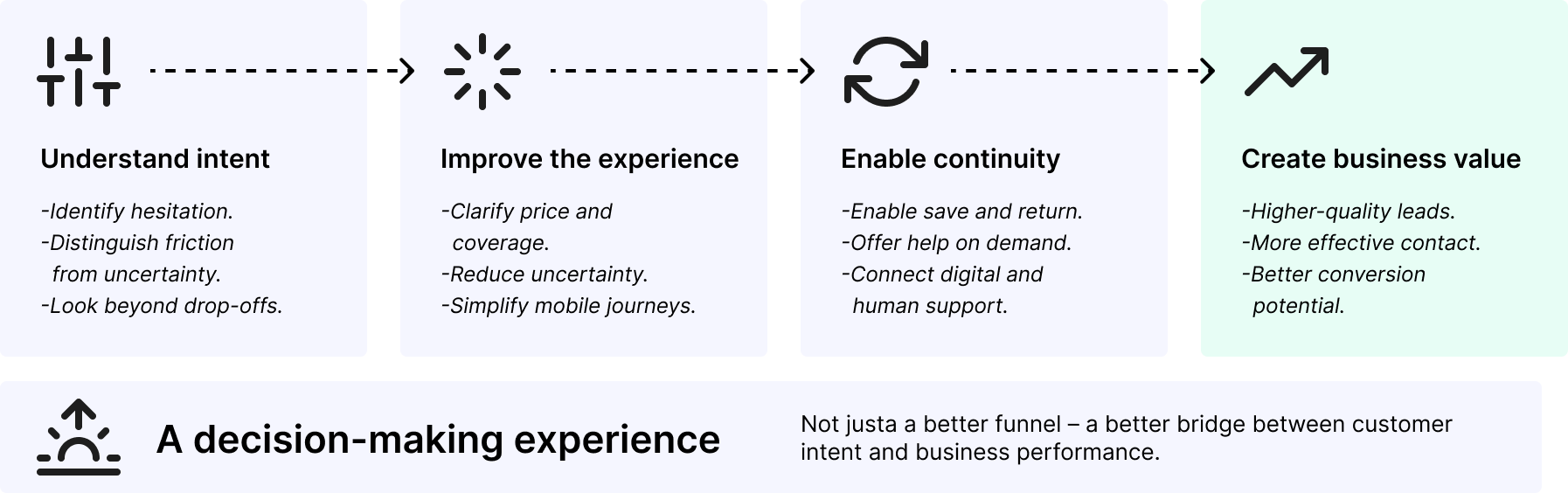
From a quotation tool to a decision-making experience
The strategy focused on evolving the digital journey without unnecessarily disrupting the underlying business systems.
Rather than redesigning screens in isolation, we reconsidered how each stage could help customers understand, evaluate, and confidently move forward.
This meant introducing clearer pricing and coverage explanations, more intuitive mobile interactions, contextual guidance, and better continuity between the different steps.
It also meant recognizing that not every customer follows the same path.
Some prefer completing the purchase independently. Others need occasional assistance, while some feel more comfortable speaking with a specialist.
Instead of treating assisted sales as a failure of digital self-service, the experience was designed to accommodate these different needs, allowing customers to save their progress, return later, or request support on their own terms.
The underlying business principle was straightforward:
Make self-service easier while making human assistance more relevant.
Connecting experience improvements with business performance
An important part of my work was translating these opportunities into a prioritized roadmap that balanced customer value, business impact, implementation effort, and technical dependencies.
Not every improvement required a major technology investment. Some opportunities involved clearer communication, better interaction patterns, or removing unnecessary uncertainty. Others depended on closer coordination between digital channels, customer management, and commercial operations.
Equally important was defining how success would be measured.
Beyond completed online sales, we established measurement criteria for intermediate decisions: progressing after viewing a quote, starting the purchase process, saving and recovering quotations, requesting assistance, and completing the journey through different channels.
This created a more meaningful framework for evaluating improvements and learning from customer behavior, rather than relying exclusively on final conversion rates.
It also connected experience decisions with broader business objectives: better-qualified opportunities, more effective customer contact, and more efficient use of commercial resources.
Building a foundation for continuous improvement
The work resulted in a redesigned customer journey, prioritized improvements, and a measurement framework to evaluate their impact as implementation progresses.
Beyond the immediate conversion challenge, the approach established reusable design and measurement principles that could support the evolution of other insurance products.
The most valuable lesson was that digital conversion is not only about helping people complete a process. It is about helping them make a decision.
When customer understanding, digital experience, business operations, and measurement work together, conversion optimization becomes something more valuable than a collection of interface improvements.
It becomes a practical way to connect customer needs with sustainable business performance.
And sometimes, making a decision means closing the laptop, having a coffee, talking it over with someone, and coming back tomorrow.
As customers, we do it all the time. As professionals, we sometimes forget to design for it.
If you share an interest in digital strategy, human behavior, and meaningful business outcomes, feel free to connect on LinkedIn.